
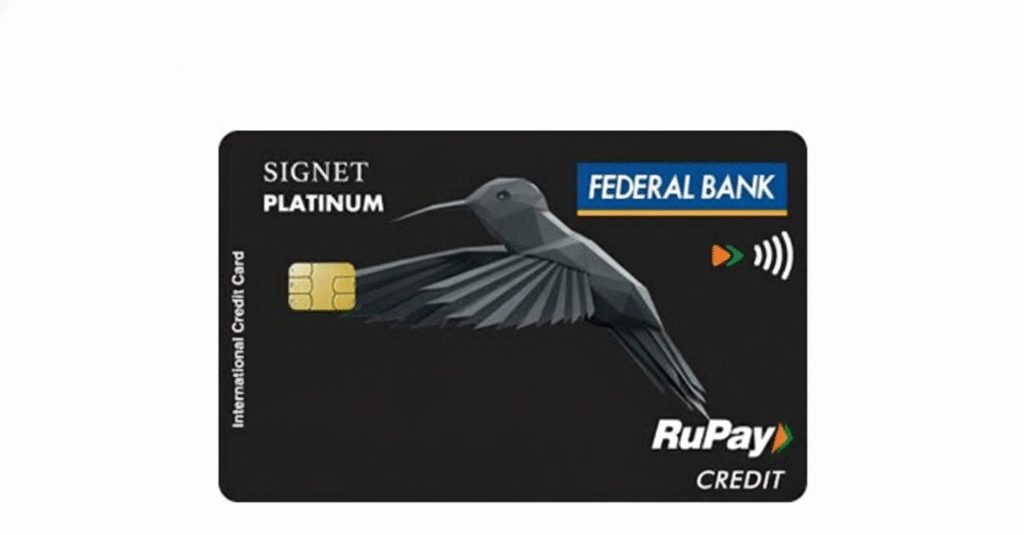
Federal Bank Signet Credit Card is a lifetime-free rewards card targeted at entry to mid-level users who spend regularly on daily categories like grocery, healthcare, electronics, apparel, utilities, and entertainment. It is one of Federal Bank’s mass-market products and is available on Visa, Mastercard and RuPay networks, with slightly different reward focuses depending on the variant.
Card Overview
Federal Bank Signet Credit Card is designed as a no-fee, high-usage card for salaried and self-employed individuals who want simple, category-based rewards rather than premium travel benefits. The bank markets it as a lifestyle card, and its 3-2-1 rewards model is clearly built around common urban spends like grocery, healthcare, shopping and entertainment.
Unlike expensive premium cards, Signet focuses on being lifetime free for most new acquisitions, which is a strong hook for first-time or value-conscious users.The card also offers differential APR based on your banking relationship, making it more attractive if you already maintain a healthy balance with Federal Bank.
Variants and Networks
Federal Bank issues Signet on multiple networks, and each network tends to focus on slightly different categories. For a blogger or reviewer, it helps to treat them as “flavours” of the same core product:
- Visa Signet:
- Focus: Healthcare and grocery as booster categories.
- Typical structure: 3X rewards on healthcare and grocery, 2X on utilities, 1X on others.
- Mastercard / RuPay Signet:
- Focus: Electronics and apparel as main booster categories.
- Often offers 3X on electronics and apparel and 2X on entertainment, with 1X on remaining spends.
Because RuPay runs on domestic rails and supports credit card on UPI, the RuPay Signet variant additionally offers UPI-based payments via apps like BHIM/PhonePe/Paytm where RuPay credit on UPI is enabled. This makes Signet RuPay particularly interesting for users who want to shift daily UPI spends onto a credit card for rewards.
Eligibility and Target Segment
Federal Bank usually targets Signet at young professionals, first-time credit card users and existing Federal Bank account holders looking for a simple rewards card. Exact eligibility (age, income, credit score) can vary by channel and campaign, but typical criteria include being at least 21 years old with a stable income and a clean credit history.
The card is especially easier to get if you already bank with Federal and maintain a decent savings or salary account, since the bank can underwrite you based on existing relationship and internal credit scoring.Non-customers may still apply, but documentation and underwriting might be slightly stricter.
Fees and Charges
One of the biggest USPs of Federal Bank Signet Credit Card is that it is marketed as lifetime free for many campaigns, i.e., zero joining fee and zero annual fee.This is particularly important for Indian users wary of hidden charges and for beginners who want to experience credit cards without recurring cost.
Key charges to highlight:
- Joining / Annual Fee:
- Generally Nil (LTF) in most current offers.
- Always confirm the schedule of charges at the time of application in case campaigns change.
- Add-on Card Fee:
- Around ₹100 per add-on card, with a maximum of four add-on cards allowed under a primary account.
- Interest / APR:
- Dynamic APR from about 0.69% to 3.75% per month, which corresponds to roughly 8.28% to 45% per annum depending on your repayment behaviour and average balance with Federal.
- Customers with strong relationships and good repayment history may enjoy better interest terms over time.
- Cash Advance:
- Cash withdrawal fee is typically around 2.5% of the withdrawn amount, with a minimum fee of roughly ₹500.
- Cash limit is usually capped at about 10% of the overall credit limit, which acts as a protection against heavy cash usage.
- Late Payment Charges:
- Slab-based, with approximate ranges like ₹250–₹1,250 depending on total amount due.
- GST is chargeable extra on fees and interest.
- Forex Mark-up:
- On the Visa/Mastercard international variants, foreign currency markup is usually around 3.5% of the transaction amount.
- This level is standard for non-premium cards in India and not a special strength of Signet.
- Reward Redemption Fee:
- Some channels list a reward redemption fee of about ₹99 per request.
- This matters for small redemptions; users should ideally redeem in bigger chunks.
Rewards Structure (3-2-1 Model)
The hallmark of the Signet series is the simple 3-2-1 rewards structure. While exact multipliers can vary by network and campaign, the pattern is consistent:
- 3X Rewards:
- High-importance categories such as:
- Healthcare (pharmacies, hospitals etc.) and grocery on Visa Signet.
- Electronics and apparel on RuPay/Mastercard Signet.
- This targets everyday expenses plus periodic shopping, ensuring consistent reward accumulation.
- 2X Rewards:
- Mid-tier categories like utilities (Visa) or entertainment (RuPay/Mastercard).
- The idea is to give a moderate boost on bills and leisure spending.
- 1X Rewards:
- All other eligible retail transactions typically earn 1X reward rate.
- Fuel often earns 0 or reduced rewards as is standard industry practice; details depend on the current T&Cs.
Exact reward point to rupee conversion and point value may vary; issuers often price 1 point at roughly ₹0.20–₹0.25 or similar, but one must check current reward catalogue and conversion chart.[5][4] As a blogger, you can illustrate sample calculations (e.g., “₹10,000 monthly grocery at 3X vs 1X”) once you pull the exact point value from the official catalogue.
Welcome Benefits and Offers
In many acquisition campaigns, Federal Bank pairs Signet with co-brand or welcome offers, especially around Amazon or other e-commerce brands.Typical examples include:
- Amazon Pay voucher on successful card activation and first transaction, sometimes with a minimum spend condition within a defined period.
- Limited period cashback or bonus reward points on achieving a threshold spend in the first 30–90 days.
These offers are time-bound and change frequently, so any blog or video content should clearly state that users must check the latest welcome benefits on the Federal Bank website or acquisition page.
Other Benefits and Features
Apart from core rewards, Signet carries a set of standard credit card features, plus some extras depending on variant. These are usually not as heavy as premium cards but adequate for an LTF mid-segment product.
Common benefit themes:
- Contactless Payments:
- All Signet variants support contactless (tap-and-pay) transactions within RBI limits, improving convenience and checkout time.
- EMI Options:
- Merchant EMI and conversion to EMI for large purchases through net banking/mobile app or via customer care.
- This is useful for the electronics/apparel category where RuPay/Mastercard Signet gives 3X rewards and users may still want to spread payments.
- Security Features:
- Instant card block/unblock via mobile banking or internet banking, SMS alerts for all transactions, and sometimes zero liability on lost card after reporting.
- These are standard but important to mention for consumer trust.
- RuPay UPI-on-Credit (RuPay Signet):
- Ability to link the credit card to UPI apps and pay using RuPay credit on UPI, with rewards on eligible merchant transactions.
- This is a differentiator versus many older cards that do not support UPI-based credit usage.
Some sources also mention periodic tie-ups for offers such as discounts on dining, movies or partner brands using Signet, normally communicated via SMS, email or offer pages.
Reward Redemption
Redemption of rewards on Signet generally happens through Federal Bank’s rewards platform or partner catalogue.Users can convert points into:
- Statement credit or cashback type value (depending on scheme).
- E-vouchers for popular e-commerce or retail brands.
- Merchandise or experiences (usually lower value per point than vouchers/credit).
The reward redemption fee (around ₹99 per request on some variants) makes it economically better to redeem in larger chunks instead of small, frequent redemptions.Cardholders should also stay aware of reward expiry timelines, which are usually a few years from accrual date.
APR and Relationship-Based Pricing
A unique talking point for Federal Bank Signet is the dynamic APR linked partly to your usage and relationship.Rather than a single flat rate for everyone, the product uses slabs (for example, ~0.69%–3.75% per month) and assigns cardholders a band depending on their repayment behaviour and sometimes their balances with Federal.
This approach rewards disciplined users and good customers with potentially lower cost of revolving credit, though from a pure financial planning perspective, revolving balance at any interest rate should be avoided if possible. For your blog, it is worth highlighting this as a “soft benefit” for existing Federal customers who might get better APR compared to another bank with a flat high rate.
Pros and Cons
From a product review angle, the Signet card has a clear positioning with notable strengths and some trade-offs.
Pros:
- Lifetime free structure with no joining or annual fee in most current campaigns.
- Simple, easy-to-explain 3-2-1 rewards model on everyday categories (grocery, healthcare, electronics, apparel, utilities, entertainment).
- RuPay variant supports UPI on credit, which fits Indian consumers’ current payment behaviour.
- Relationship-based APR that can be beneficial to good Federal Bank customers.
Cons / Limitations:
- Reward rate and exact point value are not as aggressive as some super-premium or aggressively promoted cashback cards; value depends heavily on your spend mix and redemption style.
- Forex mark-up (~3.5%) is standard, not a benefit for heavy international travellers.
- No major travel perks like airport lounge access (except where bundled via RuPay network domestic lounge benefits, which are limited and changeable).
- Reward redemption fee makes small redemptions inefficient.
Ideal User Profile and Practical Use Cases
Federal Bank Signet Credit Card works best for users whose spending is tilted towards everyday categories instead of premium travel. A typical ideal user could be:
- A salaried professional in Tier 1–2 city who spends monthly on: groceries, medical expenses, utility bills, OTT/subscriptions, and occasional electronics or apparel shopping.
- An existing Federal Bank savings/salary account holder who wants a lifetime-free card and is comfortable managing everything from one bank.
Some practical use-case strategies you can highlight:
- Use Visa Signet for monthly grocery and medicine purchases to maximise 3X rewards.
- Use RuPay/Mastercard Signet for planned gadget or apparel buys, converting big-ticket items into EMI after earning the initial 3X points.
- Route regular UPI merchant payments (where allowed) through RuPay Signet to earn points on payments that would otherwise be from savings account.